REVIEW · CITY TOURS
Self-Guided Chicago Loop Tour Explore the City at Your Own Pace
Book on Viator →Operated by Drives & Detours · Bookable on Viator
Chicago looks different when you walk it. This self-guided Loop tour uses GPS-triggered audio to point you toward major landmarks, and I like the flexible pace that lets you linger for photos. One thing to watch: you’ll need to download the app (and have your own smartphone) before you start.
At just $9.99 per person, the value is hard to beat for 2 to 2.5 hours of curated highlights. The route runs from DuSable Bridge at 333 Michigan Ave to Willis Tower at 233 S Wacker Dr, and the tour is in English with a mobile ticket.
You can use it offline once it’s downloaded, so you’re not hunting for cell service downtown. Still, because the audio auto-plays based on where you are, you’ll want to pay attention when you’re crossing between stops or cutting through blocks.
In This Review
- Key points to know before you go
- Why This Loop Route Fits Chicago So Well (DuSable Bridge to Willis Tower)
- Price and Value: $9.99 Buys a Lot of Meaning
- The App in Real Life: Offline Audio, GPS Cues, and a Simple Flow
- Stop-by-Stop: What You’ll See and Why It Matters
- Start Near the River: DuSable Bridge
- The Art Moment: The Museum With American Gothic
- Buckingham Fountain: Chicago’s Big Water-Show Icon
- Board of Trade: Art Deco Meets the City’s Finance Past
- Chicago Cultural Center: Free Art and a Dome That Stops You
- Cloud Gate: The Bean and the City’s Reflection
- Crown Fountain: A Playful Stop That Works Best in Warm Weather
- Jay Pritzker Pavilion: Gehry’s Steel Ribbons in Millennium Park
- Millennium Monument: A New Take on a 1917 Colonnade
- Calder’s Flamingo: The Loop’s Big, Friendly Pop of Color
- A 1895 Chicago-School High-Rise With Terra-Cotta Detail
- The Picasso: An Abstract Icon With a “Look Again” Problem
- The Rookery Building: Wright’s Light Court Inside an Old-School Landmark
- Willis Tower: Panoramic Views and The Ledge Option
- Inside a Working Bridgehouse: Michigan Avenue’s Gears and How the River Moves
- Vietnam Veterans Memorial Plaza: A Quiet Pause by the Water
- Chicago Theatre: French Baroque Grandeur and a Classic Marquee
- Harold Washington Library Center: A Winter Garden Escape
- Miro’s Chicago: A Surreal Splash in the Loop
- How to Time It (So You Don’t Feel Rushed)
- Who Should Book This Self-Guided Loop Tour?
- Should You Book It? My Take
- FAQ
- How long is the self-guided Chicago Loop tour?
- Where does the tour start and where does it end?
- What language is the audio guide in?
- Does it work offline?
- Do I need to bring a smartphone?
- Are admissions included for the stops?
- Can I cancel and get a refund?
Key points to know before you go
- GPS-triggered audio plays automatically as you reach each stop, so you’re not fumbling with your phone every minute
- Offline after download means no cell signal needed once you’ve started
- Unlimited access: buy once, use any day/time, and the access never expires
- Most stops are listed as free with this route, which makes the price feel even smarter
- Start and end points are fixed (DuSable Bridge to Willis Tower), so plan your day around that walk
Why This Loop Route Fits Chicago So Well (DuSable Bridge to Willis Tower)
This tour gives you a simple mission: walk the Chicago Loop at your pace, with audio that tells you what you’re looking at. Starting at DuSable Bridge puts you right by the river, and ending at Willis Tower helps you finish with one last big city-view payoff.
The route is designed for “slow travel.” The listed time per stop is short, but the best part is that the audio doesn’t force you to rush. You can stop for a closer look at architecture, step away for photos, and come back when you’re ready.
One practical note: the Loop is a grid, but it’s also busy. If you’re crossing streets frequently, give yourself a little extra time so you don’t feel stressed when the GPS cue comes at an inconvenient moment.
You can also read our reviews of more guided tours in Chicago



Price and Value: $9.99 Buys a Lot of Meaning
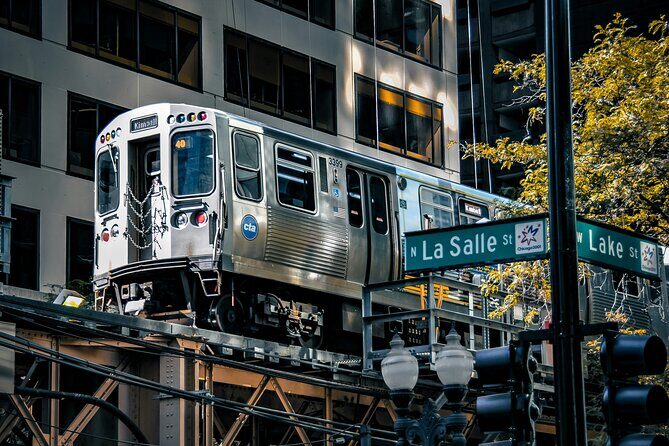
For $9.99, you’re paying for more than narration. You’re buying a lightweight guide that keeps you from walking past impressive places with no context.
What makes the price feel especially reasonable is that the tour lists free admission for the stops it covers (you still want to confirm what’s required in-person, but the tour is clearly aiming for low-cost sightseeing). That means you can spend your money on the things that cost more to visit in Chicago, instead of paying for a ticketed tour.
Also, the tour’s unlimited access is a quiet win. You can use it on another day if you’re tired that first afternoon, or re-listen to sections while you’re waiting for something else nearby. That flexibility turns one payment into multiple chances to get it right.
The App in Real Life: Offline Audio, GPS Cues, and a Simple Flow
This is a mobile ticket experience. You download the Drives & Detours app, then use a code to redeem and start the tour. After that, the tour runs with an audio guide in English.
The key feature is that it works offline once downloaded. That’s a big deal in the Loop, where service can be spotty in pockets and you don’t want to burn your battery chasing bars.
The audio is GPS-triggered and plays automatically when you’re near each stop. I like this style because it keeps you moving, but it also means you’ll want to keep your phone accessible and your location turned on. If you walk with the screen buried in a pocket, you might miss the moment the cue fires.
Finally, this is set up as a private tour/activity. In practical terms, you’re doing it for your group, on your own schedule—no herd lines and no “follow the guide” pressure.
Stop-by-Stop: What You’ll See and Why It Matters
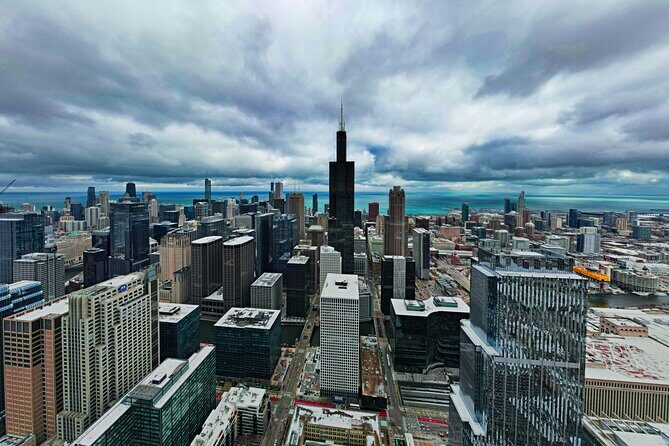
Start Near the River: DuSable Bridge
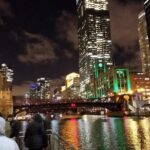
You begin at DuSable Bridge, a double-deck, double-leaf bascule crossing that connects Chicago’s north and south sides. This is a smart start because it orients you fast: you get the river setting, the bridge engineering, and the sense of Chicago as a city shaped by waterways.
If you’ve never watched a lift bridge in action, the bridge’s design language is its own intro to the city’s mechanical confidence. Even without any special effects, it’s a solid way to get oriented before you drift into landmarks.
You can also read our reviews of more city tours in Chicago





The Art Moment: The Museum With American Gothic
One of the first stops is a major art museum famous for iconic works like American Gothic and set inside a striking Beaux-Arts building. If you like art that explains a place’s identity—rather than art that only tries to shock—you’ll probably enjoy this stop.
The value here is that you’re not just stepping into a big building. The audio helps you connect the building and the collection, so you know what to look for while you’re moving around.
If you’re short on time, you might still get a lot out of the highlights. If you’re the type who can spend an hour staring at one painting, set expectations: this is a stop where you’ll want to slow down.
Buckingham Fountain: Chicago’s Big Water-Show Icon
Next up is Clarence F. Buckingham Fountain, one of the world’s largest fountains with a central jet that reaches about 150 feet. It’s also inspired by Versailles, so you get that European grandeur—but in a very Chicago way.
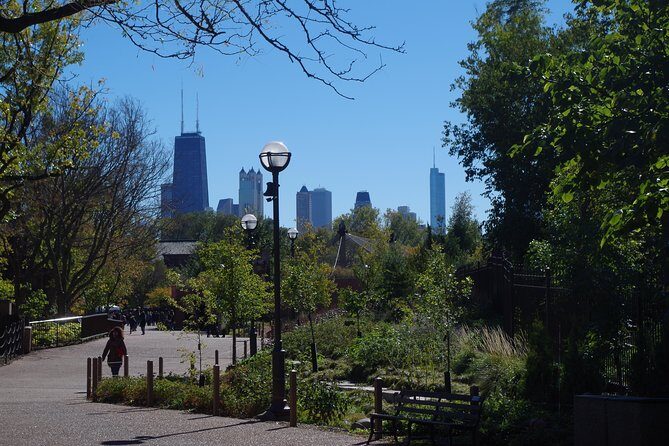
The best part is the setting. You’ll see how the fountain frames the skyline, which makes it feel more like a monument than a random plaza feature. This is a great stop even if you don’t plan to hang around for a long time.
Outdoor tip: this is the kind of place where the weather changes the experience fast. If it’s windy, you’ll notice it.
Board of Trade: Art Deco Meets the City’s Finance Past
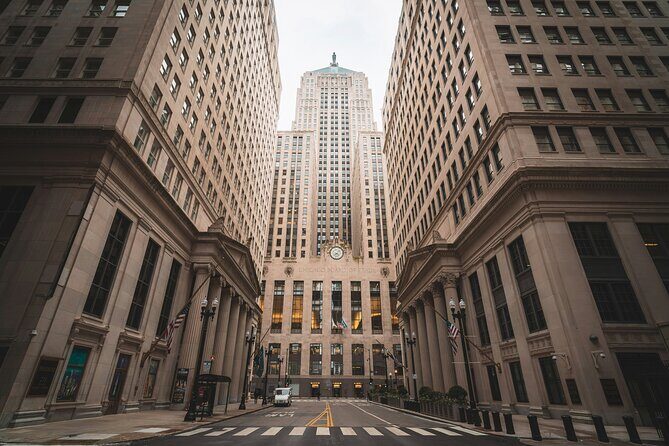
At the Chicago Board of Trade Building, you’re looking at a soaring Art Deco tower once tied to the city’s trading district. The audio points out the statue of Ceres, and that little detail is useful because it turns “cool building” into “specific story.”
If you like architecture, the lobby is where you’ll feel the most payoff. It’s the kind of place where a few minutes of looking can turn into a longer stop once you notice the ornament.
Chicago Cultural Center: Free Art and a Dome That Stops You
The Chicago Cultural Center is a former library turned free cultural hub. The highlight here is the stained-glass domes—details you’ll notice from far away, but only really appreciate once you’re inside.
This is one of the stops I’d use as an easy reset. If you’ve been walking for a while, you can step inside, catch your breath, and let the building’s light do the work for you.
Cloud Gate: The Bean and the City’s Reflection
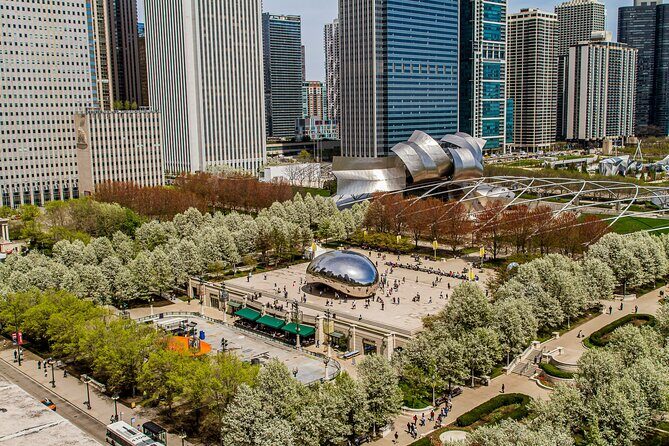
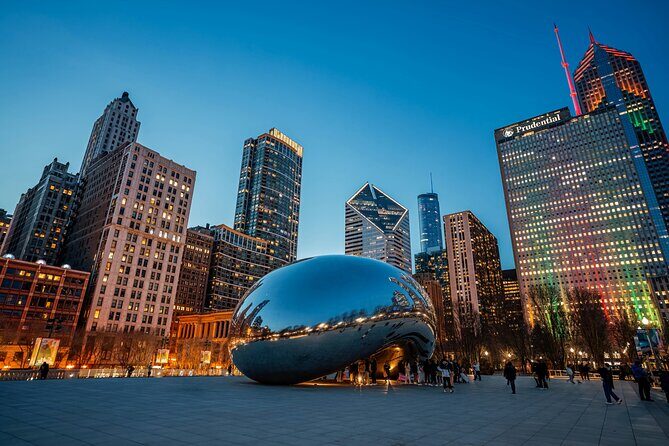
Cloud Gate is the instantly recognizable sculpture people photograph from every angle. What the audio helps with is the idea that you’re not separate from it—the reflective surface turns the skyline (and you) into the artwork.
Walk up close. Look for how the reflections distort your surroundings. That’s where it becomes more than just a photo spot.
Crown Fountain: A Playful Stop That Works Best in Warm Weather
At Crown Fountain, two glass block towers display video portraits, and they spray water during the summer. Even if you don’t time it perfectly, it’s still a fun, modern interruption in a city that can feel more formal than people expect.
If you’re visiting in cooler months, the interaction may feel less active. Still, it’s worth seeing as public art designed for people, not just passersby.
Jay Pritzker Pavilion: Gehry’s Steel Ribbons in Millennium Park
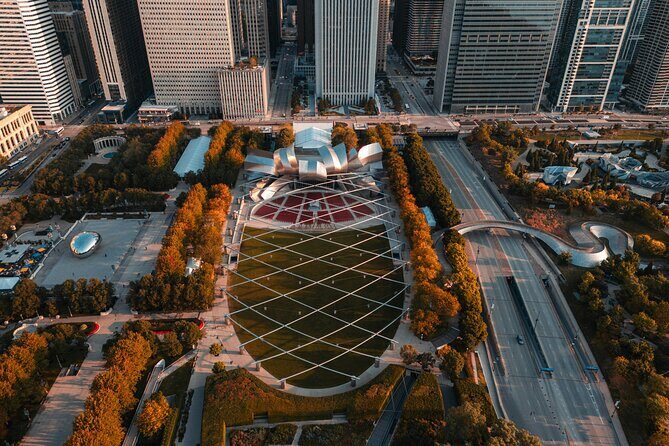
The Jay Pritzker Pavilion anchors Millennium Park. Designed by Frank Gehry, it’s an outdoor concert venue with dramatic steel shapes and a major sound system.
Even if you never catch a show, the structure is fun to study because it looks like motion frozen in steel. It’s a reminder that the Loop isn’t only old skyscrapers—it has modern engineering confidence too.
Millennium Monument: A New Take on a 1917 Colonnade
The Millennium Monument is a modern recreation of a 1917 colonnade. It honors the city’s founders, but it doesn’t feel like a dusty memorial. Instead, it’s integrated into the park space so you encounter it while you’re moving.
This is a good “two-minute anchor” stop. It gives you a sense of what Chicago wants to remember while you’re surrounded by contemporary architecture.
Calder’s Flamingo: The Loop’s Big, Friendly Pop of Color
Calder’s Flamingo brings a bold red sculpture into the mix. The curves contrast with the surrounding steel and glass, and the size makes it feel slightly theatrical.
If you’re tired of straight lines, this is where the city gives you permission to relax. It’s also the kind of art where people naturally form a little orbit around it for photos.
A 1895 Chicago-School High-Rise With Terra-Cotta Detail
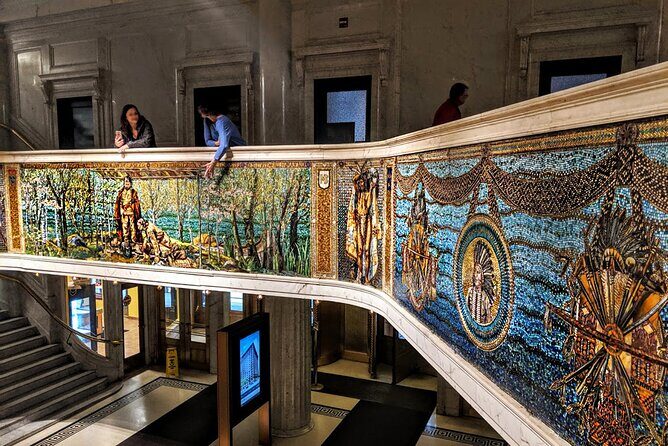
There’s also a stop at a 1895 high-rise tied to the Chicago School. The tour calls out ornate terra cotta, a luminous interior rotunda, and mosaics that tell a story about early explorers.
This is the type of stop that rewards slow looking. The exterior gets attention, but the interior details are where you’ll likely feel the wow factor.
If you only glance at the façade, you’ll miss the main point. Try to aim for at least a short indoor look if it’s open.
The Picasso: An Abstract Icon With a “Look Again” Problem
At The Picasso, you’ll find an abstract steel sculpture that people recognize immediately. It’s a gift from Pablo Picasso, and the tour notes that meaning is intentionally left to interpretation.
I like this kind of stop in a self-guided tour because it’s a conversation starter with yourself. You can decide what it suggests before you move on—no right answer required.
The Rookery Building: Wright’s Light Court Inside an Old-School Landmark
The Rookery Building combines older high-rise style with a redesigned light court tied to Frank Lloyd Wright. The tour highlights a blend of Romanesque and early skyscraper design, plus that unique interior light setup.
This one works well if you’re into architecture that’s about more than height. It’s old-school grandeur with a modern twist, and you don’t need a long time to sense why it’s famous.
Willis Tower: Panoramic Views and The Ledge Option
You finish at Willis Tower, formerly the tallest building in the world. The audio points you to the Skydeck on the 103rd floor and mentions stepping onto The Ledge for a glass-floor thrill.
This is the stop where you might spend more than a few minutes, because views are views. Whether you choose The Ledge depends on your comfort level with glass and heights, but the audio will at least make sure you know exactly what’s there.
Plan for a longer finish if you want photos from multiple angles.
Inside a Working Bridgehouse: Michigan Avenue’s Gears and How the River Moves
The tour also includes a stop where you can climb inside a working bridgehouse to see gears that lift the Michigan Avenue Bridge. This is an excellent break from looking at faces and façades, because it’s functional engineering up close.
It also gives you a new way to think about the river: not just as scenery, but as a system that moves boats and cars through the same space.
Vietnam Veterans Memorial Plaza: A Quiet Pause by the Water
Near the river you’ll reach the Vietnam Veterans Memorial Plaza, a peaceful reflective spot. The tour notes polished granite walls that reflect names and memories.
This is a good moment to slow down, stop taking photos for a minute, and just read. In a day packed with landmarks, this kind of place balances things out.
Chicago Theatre: French Baroque Grandeur and a Classic Marquee
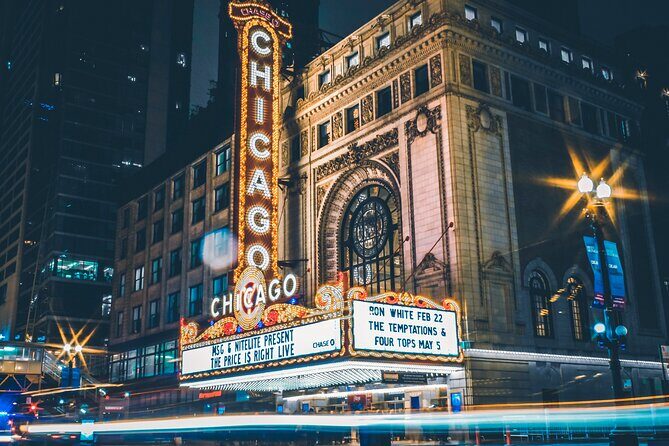
At the Chicago Theatre, the exterior marquee and the lavish French Baroque interior are both major draws. The tour presents it as a showstopper you can enjoy from outside and step into if you want the full impact.
If you like theaters—especially old-school ones—this is a strong stop. Even if you don’t attend a performance, the building is a reminder that Chicago loves big stages.
Harold Washington Library Center: A Winter Garden Escape
The Harold Washington Library Center has a sunlit glass atrium and a Winter Garden that feels like a hidden pause from the street noise. This is a practical stop because libraries make your legs feel better.
It’s also one of those Chicago places where architecture and calm work together. You don’t have to rush it.
Miro’s Chicago: A Surreal Splash in the Loop
The last stop is Miro’s Chicago by Joan Miró—whimsical, colorful, and open to interpretation. It’s surreal in a friendly way, and it keeps the tour from ending on something purely monumental.
This is a good ending if you want your final photo to look playful rather than formal.
How to Time It (So You Don’t Feel Rushed)
The tour is listed as about 2 to 2.5 hours, with short audio segments designed for efficient sightseeing. In practice, it’s easy to go longer because so many stops invite photos, quick interior peeks, or just standing still to absorb details.
I’d plan around a half-day mindset. Shoes matter. The Loop is walkable, but the distances add up when you stop at almost everything.
If you want a faster day, keep your indoor stops short and let the audio carry you to the next highlight. If you want a calmer day, linger near Millennium Park and inside the buildings with domes and light courts.
Also, bring a portable charger if you’re the type who takes lots of pictures. The tour is offline, but your camera still uses power.
Who Should Book This Self-Guided Loop Tour?

This is a great fit if you want:
- A low-cost way to see a lot of Chicago landmarks without joining a guided group
- Flexible pacing (you can linger or skip a stop without ruining anything)
- Architecture and public art focused sightseeing, with audio context at each place
- A plan that works even when you don’t want to schedule a “big activity”
I’d skip it (or at least think twice) if you hate using apps on vacation, or if you don’t like GPS location cues. The tour runs best when your phone stays ready and your walking pace is consistent.
Should You Book It? My Take
Yes, I’d book it if your goal is a satisfying Loop day with built-in context and no ticket-bundling headache. The combination of audio you can use offline, GPS-triggered timing, and unlimited access makes the $9.99 price feel like a practical investment, not a gimmick.
If you’re the type who only wants one or two major stops, you may find it costs more attention than you need. But if you want a real sampler platter—from the Bean and Crown Fountain to classic buildings and a final skyline finish—this tour is a smart way to do it.
FAQ
How long is the self-guided Chicago Loop tour?
The tour is listed at about 2 hours to 2 hours 30 minutes.
Where does the tour start and where does it end?
It starts at DuSable Bridge, 333 Michigan Ave, Chicago, IL 60601, USA and ends at Willis Tower, 233 S Wacker Dr, Chicago, IL 60606, USA.
What language is the audio guide in?
The audio guide is offered in English.
Does it work offline?
Yes. Once downloaded, the tour works entirely offline, and it does not require cell service.
Do I need to bring a smartphone?
Yes. The tour requires a smartphone, and you’ll need your own device.
Are admissions included for the stops?
The tour listing shows each stop with Admission Ticket Free, indicating the stops are presented as free within this route.
Can I cancel and get a refund?
Yes. You can cancel for a full refund up to 24 hours in advance of the experience’s start time, with no refund if you cancel less than 24 hours before.