REVIEW · GUIDED
Architecture & History Guided Tour along the Chicago Riverwalk
Book on Viator →Operated by Tours By Foot - Chicago · Bookable on Viator
Chicago’s river has a story to tell. This 2-hour walk turns the Chicago Riverwalk into a living timeline, with a professional local guide pointing out what to notice in the buildings, the river bends, and the moments in between. I especially love how the pace stays friendly: short stops, clear explanations, and lots of chances to look up and look around on an easy riverfront route.
Two things I liked a lot: I got great context for landmarks like Marina City (yes, the corn cob look) and the Tribune Tower, and my guide Kathryn made the history feel practical instead of textbook. One thing to keep in mind: each highlight is brief, so if you like to linger at viewpoints or read every plaque for a long time, you may want extra time afterward on your own.
In This Review
- Key things you’ll notice on this Chicago Riverwalk tour
- Meeting at Wacker Drive: How the 2-Hour Loop Feels
- Stop 1: Chicago Riverwalk and Why the River Still Matters
- Stop 2: Fort Dearborn Grounds and Chicago’s Military Past
- Stop 3: Marina City’s Corn-Cob Shapes (and How to See Them)
- Stop 4: Tribune Tower in Neo-Gothic Style
- Stop 5: Centennial Fountain and Water Arc
- Stop 6: The St. Regis Chicago as a Newer Luxury Marker
- Stop 7: 455 Cityfront Plaza Dr and Art Deco in a Modern Setting
- Stop 8: The Chicago River, Scenic Views, and How Chicago Grew
- Stop 9: Marina City Again, Closer Look at the Corn Cob Detail
- Stop 10: Jewelers Building and the Former Diamond District
- Stop 11: AMA Plaza and Modern Minimalism by a Key Master
- What You’ll Actually Learn (and What This Tour Doesn’t Try to Do)
- Price Value: Why Admission-Free Stops Still Feel Worth It
- Who This Chicago Riverwalk Tour Fits Best
- Should You Book the Chicago Riverwalk Architecture & History Guided Tour?
- FAQ
- How long is the Architecture & History Guided Tour along the Chicago Riverwalk?
- Where does the tour start and end?
- What time does the tour begin?
- What language is the tour offered in?
- Is there a mobile ticket?
- How large is the group?
- Is it free to enter the stops?
- Can I get a refund if I cancel?
Key things you’ll notice on this Chicago Riverwalk tour
- Small group size (up to 18) keeps the guide’s pace comfortable.
- Mobile ticket means you can show up ready without paperwork stress.
- A tight mix of old and new: Fort Dearborn-era ground to modern luxury and media buildings.
- Marina City shows up twice, so you get both the bigger-picture view and a closer look.
- All stops are admission-free, so your money goes to the guide and walking time.
- River-focused storytelling helps you understand why Chicago grew where it did.
Meeting at Wacker Drive: How the 2-Hour Loop Feels
You start at 1 W Wacker Dr, Chicago, IL 60601, right near the riverfront action. The tour runs about 2 hours, with the day’s main value coming from how compact it is: you cover a lot of Chicago iconography in a manageable walk, without needing to shuffle between far-apart neighborhoods.
What makes this format work is the stop timing. You’ll get roughly 5 to 20 minutes at each location, which is long enough for the big ideas and short enough to keep energy up. This is a good choice if you want structure for a first pass at the Riverwalk and nearby architecture, but it’s not the type of tour where you can expect to take a long break, explore interiors, or get stuck deep in one single building.
Also, because it’s a guided walk in English and capped at 18 people, the experience tends to feel like a conversation with a route plan. When I’m on a river walk tour, I want to avoid the chaos of herding—this one is set up to keep things under control.
You can also read our reviews of more guided tours in Chicago


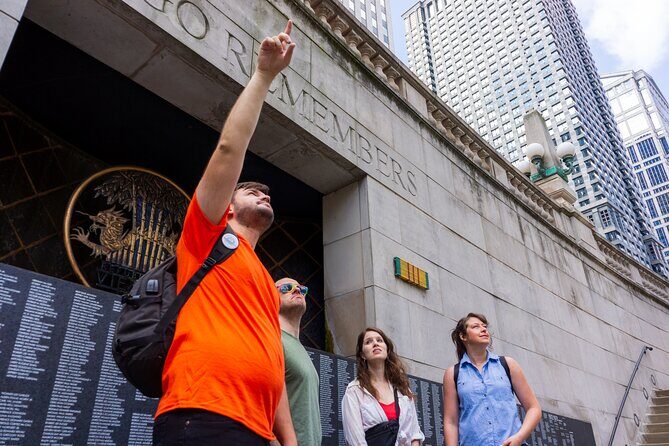
Stop 1: Chicago Riverwalk and Why the River Still Matters
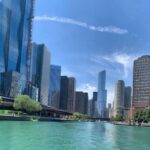
The tour begins on the Chicago Riverwalk, where you’re reminded that this waterway has been a commerce hub since the late 1700s. Even if you’ve visited Chicago before, this kind of framing helps you see the river as more than scenery. The river isn’t just a view corridor; it’s part of how Chicago worked and grew.
Here’s what I love about starting there: you’re outside, you’re close to the water, and you can immediately connect what you’re seeing—river edges, pathways, activity nearby—to what the guide explains. It sets up the rest of the walk, so later stops don’t feel random.
Possible drawback: since it’s the first stop, you’ll want to arrive on time and be ready to walk. If you’re late or spend the first few minutes texting or hunting for parking, the tour can feel like it’s already moving.
Stop 2: Fort Dearborn Grounds and Chicago’s Military Past
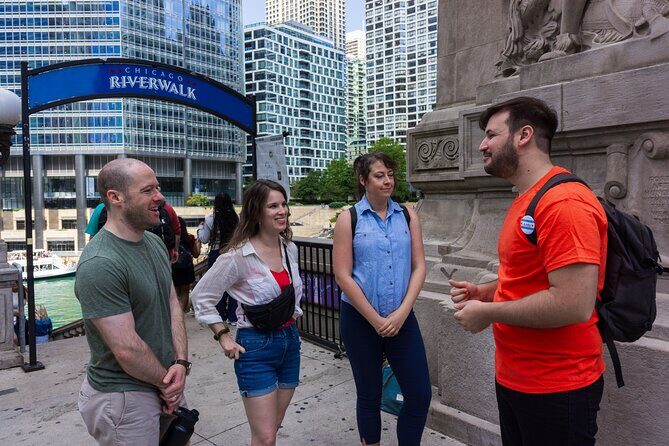
Next is the Battle of Fort Dearborn area, where the tour shifts from skyline visuals to military history. The key value of this stop is how it grounds Chicago’s story in real early conflict. You get to step back and connect the city’s later boom to earlier chapters—when the river route and settlement area mattered for survival, not just business.
This is also one of those stops where a guide helps a lot. Architecture tours can sometimes feel like a checklist. But when the story includes conflict and consequences, it turns “looking at buildings” into “understanding why people built the way they did.”
Practical tip: this is short at about 20 minutes, so don’t expect a full lecture. Instead, use it to get your bearings on what kind of early Chicago this route is tied to.
Stop 3: Marina City’s Corn-Cob Shapes (and How to See Them)
Then you reach Marina City, one of the most recognizable architectural silhouettes along the river. These cylindrical residential skyscrapers are often nicknamed the corn cobs, and the guide spends time helping you look at their design logic instead of just enjoying the form.
What I like here is that Marina City is visible from multiple angles. With a guided walk, you get the chance to understand why the buildings look the way they do as part of the river setting—how structure, height, and spacing interact with water and sky.
A small warning for your expectations: at this point, you’re still early in the tour, and you may feel like you’re “just getting started.” Give it a minute. The guide connects Marina City to what you’ll see next, so the stop has payoff even if it’s not the biggest building on the street.
Stop 4: Tribune Tower in Neo-Gothic Style
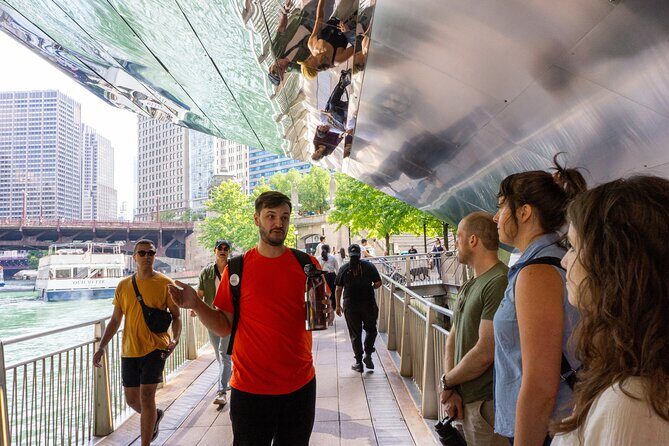
The Tribune Tower stop is brief—around 5 minutes—but it’s packed. You’ll see this neo-Gothic masterpiece, and the guide connects it to the Chicago Tribune newspaper, which once made it its home.
This is a good reminder that architecture is often media. A newsroom needed identity and presence, and this tower gave it both. When you walk past buildings like this on your own, it’s easy to admire style but miss why the building mattered to everyday city life. The guided stop helps fix that.
If you want to do a quick photo: aim for clean lines, keep the camera level, and watch reflections. The river area can create bright glare depending on the day.
You can also read our reviews of more historical tours in Chicago




Stop 5: Centennial Fountain and Water Arc
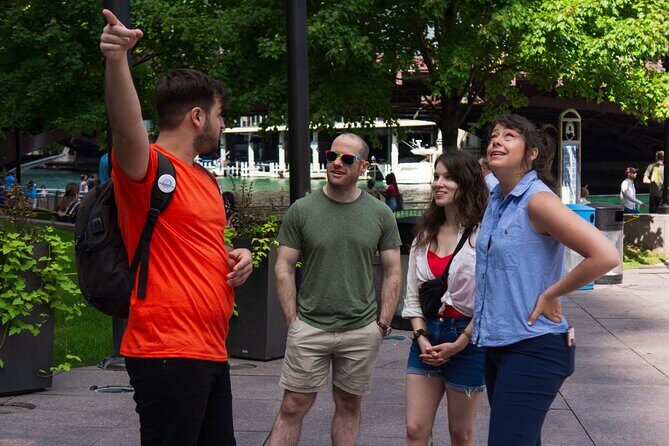
Next comes the Centennial Fountain and Water Arc, also about 5 minutes. This is a commemoration stop—built to mark major milestones in Chicago’s history. Water features always look good on a riverfront, but the key here is context: the fountain isn’t decoration. It’s a city marker.
If you’re the type who likes “meaning behind the view,” this stop delivers. If you prefer only modern architecture, you might find it lighter on structure details and heavier on symbolism, but it still helps you read the riverwalk as public memory.
Stop 6: The St. Regis Chicago as a Newer Luxury Marker
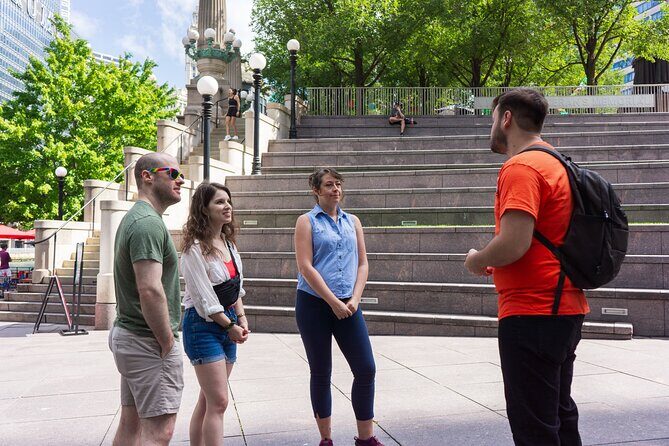
At the St. Regis Chicago, you’ll get a short 5-minute look at one of the city’s newer luxury additions. I find moments like this useful because they show how the riverfront keeps changing. It’s not frozen in time. The same corridor that once framed older settlement stories now frames new wealth, new tastes, and new silhouettes.
What to do with this stop: don’t rush the exterior view. Take a moment to compare it mentally with what you already saw—Tribune Tower on one end, modern cylinders at Marina City, and now this luxury presence. That contrast is the point.
Stop 7: 455 Cityfront Plaza Dr and Art Deco in a Modern Setting
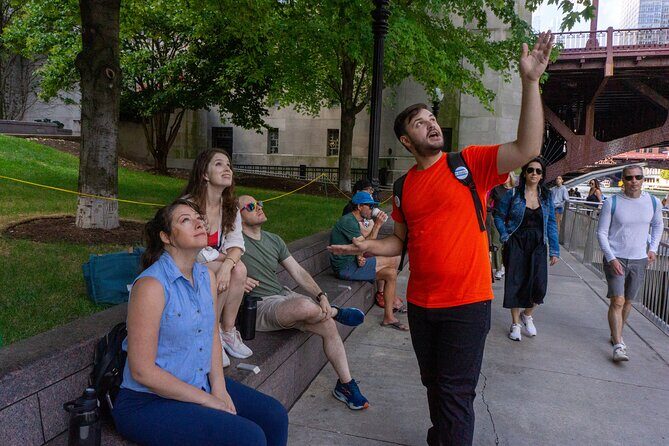
Then it’s 455 Cityfront Plaza Dr, again about 5 minutes, with Art Deco-inspired design tied to a modern media center. This stop works especially well if you like architectural “vibes” you can spot quickly—geometric shapes, stylized ornament, and the way older design languages get borrowed in later decades.
The drawback here is simply the timing. If you want to study materials and details closely, you won’t get long. But as a guided walk stop, it’s a fast way to cover a lot of visual styles without turning your day into a full-time architecture program.
Stop 8: The Chicago River, Scenic Views, and How Chicago Grew
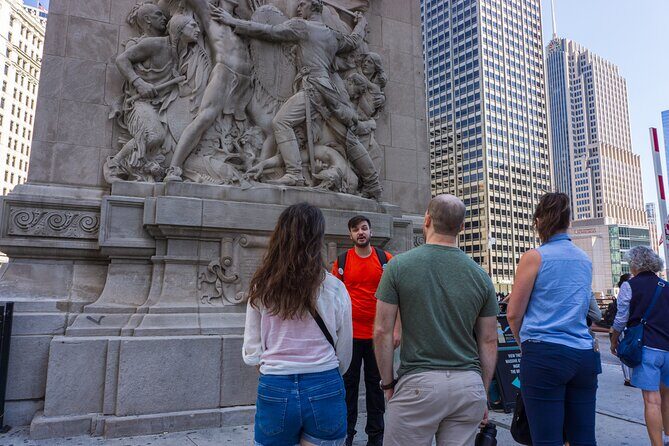
Now you shift into a 10-minute river-focused moment: the guide talks about the river’s scenic beauty and its role in Chicago’s development. This is the part that ties the route together. It helps you see the river as a driver—trade, movement, and the growth pattern that follows.
I like this stop because it’s not only about landmarks. You’re reminded that the waterway itself is the organizer of the scene. After this, the rest of the walk feels like a set of “evidence points,” where every building relates back to the river.
If you’re sensitive to noise, try to pick a spot where you can hear the guide. Riverwalk areas can get loud depending on time of day.
Stop 9: Marina City Again, Closer Look at the Corn Cob Detail
You come back to Marina City for a closer look, about 5 minutes. This second visit is one of the smartest choices on the route. First, you get the landmark shape in context. Second, you get a more detailed view, which makes the architecture feel less like a single photo opportunity and more like a designed structure.
For me, the best part of double-show stops is that they help you stop thinking of landmarks as one-time icons. You start noticing how different angles change the story.
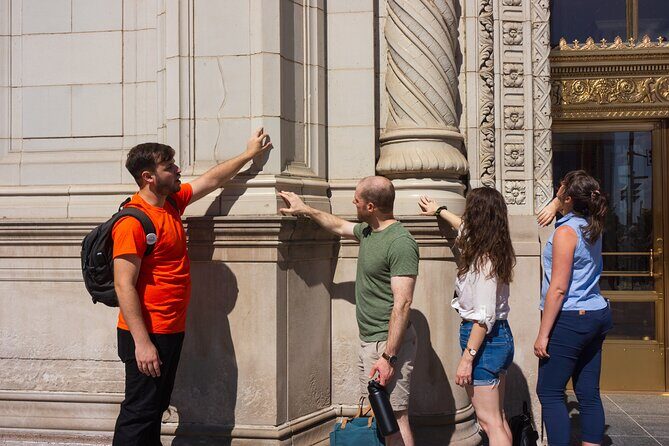
Stop 10: Jewelers Building and the Former Diamond District
At the Jewelers Building, you’ll have about 5 minutes and learn about its connection to the diamond district that once operated there. This is another “architecture as economy” stop. It’s not just style—it’s what kind of business lived in these walls.
When you understand that, even briefly, you read the building differently. Instead of seeing a static structure, you see a workplace built for a particular kind of commerce—where money, craft, and display shaped the city.
If you’re someone who loves Chicago as a business story as much as a design story, this stop clicks.
Stop 11: AMA Plaza and Modern Minimalism by a Key Master
The tour closes at AMA Plaza, also around 5 minutes, with an emphasis on its minimalist design by one of the pioneering masters of modern architecture. Minimalism can be a tough subject on a walk because there’s less ornament to “spot.” That said, a guided explanation makes it easier to see what minimal design is doing—proportion, order, and how the space reads from outside.
As you finish, you’ll likely understand the walk as a full arc: early grounds, river logic, newspaper and media influence, public celebration, luxury and modern business, and then modernist design principles at the end.
The end point is Nicholas J. Melas Centennial Fountain, 400 N McClurg Ct, Chicago, IL 60611—which is a nice fit, since it’s visually tied to the fountain milestone and keeps you anchored near the heart of the riverfront.
What You’ll Actually Learn (and What This Tour Doesn’t Try to Do)
This is a focused architecture and history walk, not a museum deep study. The value is in the route planning: you’ll see a wide spread of architectural styles and related stories without spending hours on one building.
So here’s the expectation-setting in plain terms:
- You’ll get high-level story context that makes the landmarks make sense.
- You’ll see signature exteriors and key riverfront spaces.
- You won’t be here for long interior time, full building tours, or hours of close detail on one site.
That’s not a flaw. It’s the point. In two hours, you want orientation and a set of “next things to revisit.” A tour like this gives you names and themes you can take with you—so later, when you’re walking on your own, you know what you’re looking at and why it’s there.
And with a guide like Kathryn—clear, organized, and able to connect the river to the city’s growth—it’s easier to remember what matters.
Price Value: Why Admission-Free Stops Still Feel Worth It
You might wonder why a tour needs a guide if so many stops don’t require tickets. The answer is that architecture and river history are hard to read fast. The guide acts like a translator.
Because the stops are admission ticket free, you’re not paying for entry fees at each location. Your cost goes toward:
- having someone local explain what you’re seeing,
- keeping the pace efficient,
- and making sure you connect the dots between the river, the buildings, and Chicago’s development.
If you’re spending limited time in the city, you’ll likely find this structure gives more value than wandering without a plan. You cover major sights while learning the logic behind them.
If you have lots of time and already know Chicago architecture well, you might not need a guided route for every detail. But for a first serious pass, the format is a strong deal.
Who This Chicago Riverwalk Tour Fits Best
This tour is especially suited for you if:
- you want architecture with story, not just photos,
- you’re new to Chicago or want a clean starting route,
- you like walking and learning in short bursts,
- you prefer a small group (max 18) over a big crowd.
It also works well if you’re pairing it with other city plans the same day, since it’s only about two hours and ends near another major landmark.
If you’re the kind of person who needs quiet time to read every marker for a long stretch, you might feel rushed by the stop durations. That doesn’t mean you shouldn’t go—it means you should plan a little extra free time afterward to linger where you liked most.
Should You Book the Chicago Riverwalk Architecture & History Guided Tour?
Yes—if you want a structured, two-hour way to understand Chicago through the river and the buildings that line it. This route gives you the big names (Tribune Tower, Marina City, Jewelers Building) and ties them back to why the river mattered in the first place.
I’d skip it only if you already have a strong background in Chicago architecture and you’d rather spend your time in deeper, longer-format exploring. Otherwise, this is a practical first sweep that teaches you how to “read” the riverfront on your own afterward.
FAQ
How long is the Architecture & History Guided Tour along the Chicago Riverwalk?
It’s about 2 hours (approx.).
Where does the tour start and end?
It starts at 1 W Wacker Dr, Chicago, IL 60601 and ends at the Nicholas J. Melas Centennial Fountain, 400 N McClurg Ct, Chicago, IL 60611.
What time does the tour begin?
The start time listed is 10:00 am.
What language is the tour offered in?
The tour is offered in English.
Is there a mobile ticket?
Yes, the tour uses a mobile ticket.
How large is the group?
The tour has a maximum of 18 travelers.
Is it free to enter the stops?
Each stop on the route lists admission ticket free.
Can I get a refund if I cancel?
Free cancellation is available. You can cancel up to 24 hours in advance for a full refund.